Tuesday, 25 August 2015

Bedside tables (nightstands) - Part 10b - Drawers - chopping out tailboards

Then I cut a knife wall at the base line of each scribe mark in the waste. This is to define a clean line that your chisel shouldn't go beyond. As mentioned in the previous post Frank Klausz starts his initial chop about 1/16" away from the base line so that is what I did this time too. I normally work on a sacrificial surface as I like to minimize wear to the bench top as much as I can.

Cutting a knife wall bu undercutting the scribe line
created by the marking gauge

Initial chop about 1/16" from the base line.
This is also repeated on the other side
Excavate at the waste either by simply chopping away or as I do pairing a wedge and then chop away. Do this on both sides so you meet in the middle.

Paring and chopping the waste away
Once the waste is thin enough you can chop it away and it comes out as a lump
A lump of waste being chopped out
Then hold the chisel in the base line scribe and tip it slightly at a couple of degrees off vertical. The chisel handle will be sloping away from the tail board. You can then chop to the middle of the board. Turn it over and repeat and then you will have the base lines of both edges higher than the centre,

Chopping to the centre of the board

Edges.

Removing the waste at the edges is just the same but this time you need to keep the chisel as near to plumb as you can. This will be seen and if you are off by a couple of degrees it will be obvious.

Start again cutting a knife wall with a chisel and then crosscut the waste away getting as close to the baseline as you can (I normally get around 1/32" away)

Cutting a knife wall

Some paring to be done
Now get the chisel as square as you can and simply chop (very lightly) at the waste. I normally use the same width chisel as the stock to do this.
Chopping or paring the edge waste away
while keeping as square as possible
You sometimes find that the saw-cuts are not deep enough so you have to push into the end grain to release the waste.
Paring the waste away down the angle of the dovetail
The finished results can be really good.
A little cleaning up and it will be done


Monday, 24 August 2015

Bedside tables (nightstands) - Part 10a - Drawers - a quick tip beforehand

I'd been watching a few videos showing the master dovetail maker (I know he is really a master craftsman) Frank Klausz and noticed he made dovetails similar to me except he chopped slightly in front of the base line. He removed all the waste by chopping (same as me) and then moved up to the base line and chopped to the centre of the stock on a slight inwards pointing angle (same as me). Then he turned it over to the other side and chopped again to the centre.

I did all this before but didn't chop in front of the base line so gave it a try out on these two drawers. I can report that the results are even better than before. There is very little chance of the wedge action of the chisel pushing the base line away from the line due to the small amount of waste left. I still cut a knife wall on the base line as I always have done before starting the cuts (Frank does this too).

So here are some more boring pictures of dovetailing. I used the tails first method.

I have a few of these spacers of standard thickness 1/2" 5/8" and 3/4" that I
use on my bench vise to stop it crabbing
If you have a crapo vise like mine with a central screw and twin guides you will find that when trying to hold something like a board for cutting dovetail sawcuts it will crab. The vise will stop on your stock but continue on at the other side causing it to tilt and not hold the workpiece properly. Put one of these in the other side and it will tighten properly on the stock - cost zero. Alternatively spend $$$$ on Benchcrafted hardware, a shed load of lumber and make a Roubo :) .
The piece of hardboard or ply nailed to the top of the spacer stops it continually falling on the floor when you open the vise.

A non crabbing vise

After milling all the stock to thickness which in my case was 3/4" for the drawer fronts and 1/2" for the rest of the drawer parts I squared off one end from each of the tail boards. I also cut the drawer fronts so they fit into the drawer aperture with about 1/32" clearance at the top and sides. This clearance is ok in my climate but you may wish to vary according to your own seasonal conditions.

Marking out.

Frank doesn't mark out - I do.
The first thing to do is set your marking gauge at the thickness of the tail boards, lock the gauge and then scribe all around the squared off end of each tail board. At this stage the back end of the tail boards needn't be the correct length nor square. You can adjust that later.

Using the Veritas marking gauge - I prefer this over a traditional gauge

Then mounting the board in the vise (with a spacer at the other end in my case) I used the metric (I know it's the work of the devil :) ) Incra rule to mark off from one end and then turn it over to mark from the other end.

Incra rule

Define the lines with a square and 0.5mm pencil

I then used a Veritas 1:8 saddle gauge to guide me when marking off the slope of the saw lines. Again Frank doesn't even use a pencil to mark his line he just saws away - he's been doing it a lot longer than me.


Veritas 1:8 hardwood marking saddle. You don't really need one of these
as I got away with a sliding bevel for years but they are great.

Position it so you can see the pencil mark

Mark sure you mark both sides if you are not practiced at
keeping the saw square. You can then do a little at a time
while peering over the other side from time to time

Sawing wood 

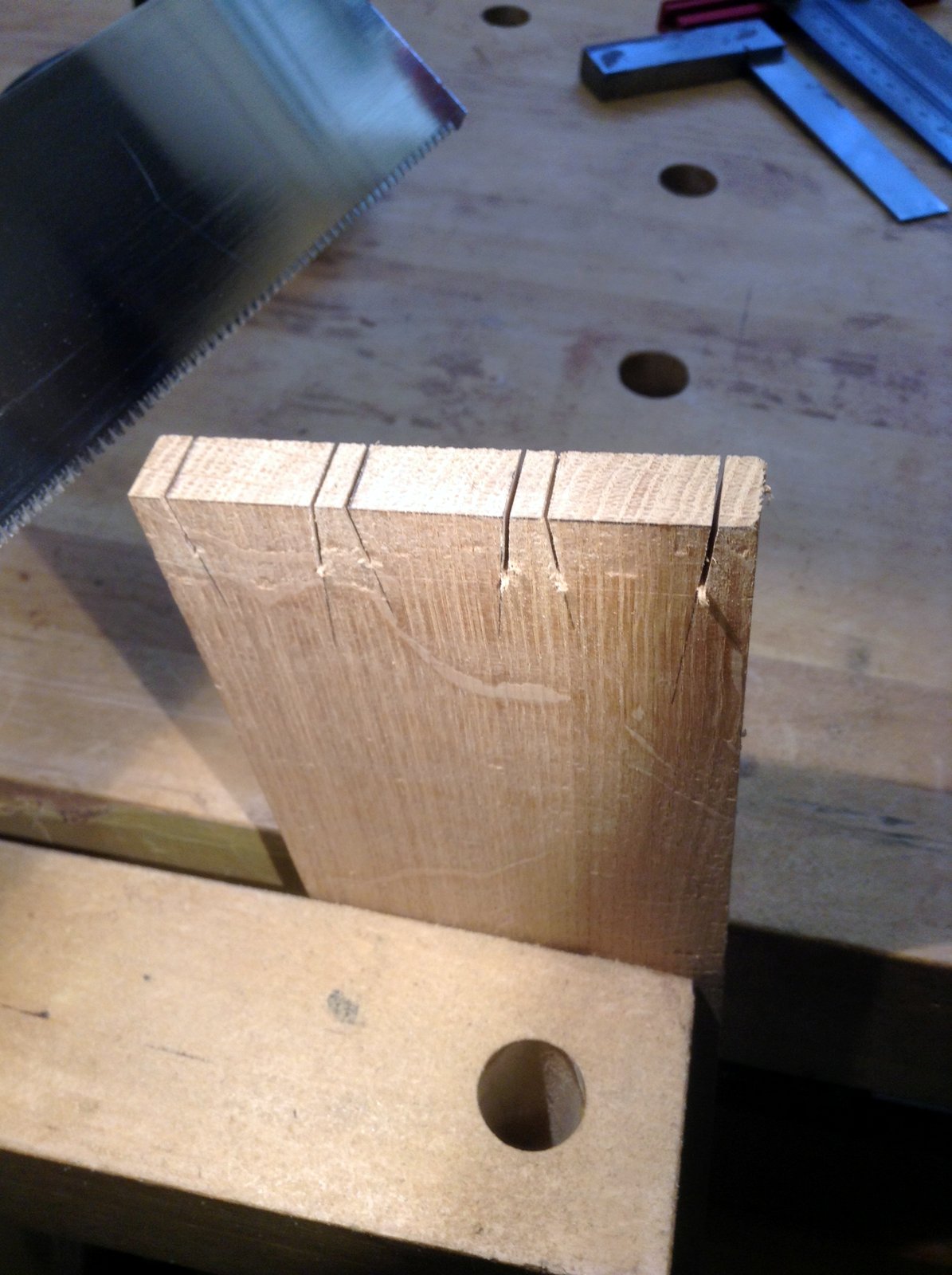
Then using a dovetail saw I cut close to the base line at all marks. I use beeswax on the teeth and plate for lubrication.
I use a japanese pull saw and have been known to use
one with a back sometimes too!

Take you time to keep the saw square to the cut and
follow the line. You are aiming to keep the
graphite on the keeper

Try to get as close to the baseline as you can
without going beyond it.


Thursday, 20 August 2015

Bedside tables (nightstands) - Part 9 - Drawer guides and top fastening rail


The drawer guides are simply 20mm (3/4") pieces of stock that are glued long grain to long grain internally. I also added a infill pieces to guide the drawer.


There are no web frames on this simple table. The top fastening rails double up as a drawer anti tilt device. I made the top fastening rails out of some 20mm (3/4") thick stock. There is one counterbored hole in the centre of the span to secure the top to the table. The other outermost holes are slotted to permit the fasteners to move due to seasonal expansion/contraction of the top. Again they are counterbored.
I chose this method of fastening the top to the table rather than using the sliding buttons method that would have required a dado to be cut in each of the aprons. As I am also using the fastening rail to double up as a drawer anti-tilt device it made sense to keep it simple.

If you haven't got one of these equi-dividers then I can really recommend them.
They take a lot of guess work out of positioning holes. You also don't need a rule to measure them off.

I marked out the centre of the fastening rail and used my pantographic equi-dividers to mark out the other holes. Then using the drill press the counterbores were machined and the through holes drilled and slotted where necessary.

The holes were (roughly) counterbored


Glueing of these parts was simply face to face long grain. No alignment biscuits, dominoes or dowels used - just glue. The parts were left to cure in clamps overnight.
A few F clamps were used on the glue up.

Once the clamps were removed the top surfaces were cleaned up

The resulting drawer aperture was ready to make the drawers


Monday, 17 August 2015

Bedside tables (nightstands) - Part 8 - Repairing a stretcher

Whilst glueing up I noticed there was some breakout at the shoulder end of one of the stretchers that would need repairing. As I was in the middle of the glueup this would have to wait until the glue had dried.
This is the view of the top of the shelf support stretcher where
it meets the leg. You can see the missing wood which would be
clearly seen when the piece was finished.

I inspected the problem and found that some of the wood had broken away on a previous operation and I just hadn't noticed it. Ordinarily I would have remade the part and trashed the flawed part  it meant I had to make running repairs.
I always keep cutoffs from a project until the project is complete for this reason. Any flaws can be repaired with pieces from the same tree and will not be that noticeable when finished.

There were several veneers that had been sliced from previous operations and I found one veneer around 1/16" thick which was ideal. The first thing I did was to square off one end. To do this I applied some blue tape to support the fibres whilst cross cutting on the table saw. I could have done it by hand with a hand saw and shooting board but the TS was handy. Then I measured the inside dimension between legs where the veneer was going to go. I applied some more blue tape to the veneer and struck a pencil line.
Cross cutting the supported end of the veneer on the table saw.
I then cross cut the veneer on the TS close to the line. I then went through a process of sneaking up on the cut until it fitted perfectly between the legs.

After sneaking up on the cut the piece fit precisely between the legs
 Then I simply glued the veneer to the stretcher with some Titebond II Dark and held it in place with yet more blue tape. I should really buy shares in 3M and Scotch as I get through masses of blue tape. This was then left to cure overnight.

Blue tape clamping


The next day I removed the blue tape and used a block plane (the Stanley #130 is ideal for this type of work) and chisel plane to trim the overhang flush. It was then finished off by using sandpaper on a block to re-establish and blend the roundover.

Using the #130 to remove excess

Trimming with the chisel plane

The results were really good and the tearout was no longer seen. I still had a void to fill and did this with some sapele dust mixed into some CA glue. The filled void would be covered by the lower shelf and would not be seen on the final project.

The repaired stretcher shelf support now looks ok

A sliver of wood at the joint remains but
can be removed with a scalpel.