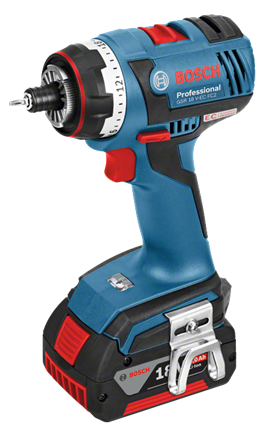
An essential tool for use in the shop is some sort of drilling device. In the old days a brace or "egg beater" drill would suffice. Nowadays they have been supplanted by cordless drills. I needed an extra cordless drill for the shop as sometimes you need a few drills setup to do different tasks (drilling, countersinking, screwdriving) so I thought I would have a look at the Bosch range.
I already have several Bosch Blue Professional tools and seem to have bought into the LBoxx systainer storage system. If you are into Festool or Dewalt of course you may have gone down their respective storage routes.
The Bosch Professional 18 volt family is wide ranging, Drywall screwdrivers, impact (percushion) tools, hand held circular saws, jigsaws, impact drivers/wrenches, combination tools and of course handheld drills.
The Bosch GSR18V-EC is part of the Bosch Professional 18V family and has a powerful EC brushless motor. It also has the "FlexiClick" system enabling it to take a range of interchangeable tool holders.
 |
| In its basic form it comprises a hex tool holder |
 |
| It also comes with a 13mm (1/2") Auto-Lock chuck. No tools are needed for the latter like most drill chucks these days. |
The brushless motor gives a long life and low battery drain. The drill was supplied in an L-Boxx 136 with internal moulded dividers.
The drill has the usual controls
- 2 speed Gear control Low/High
- Direction rotation clockwise/anti-clockwise (counter-clockwise US)
- 18 position torque setting
- Battery charge condition
- Bright LED illumination
So nothing new there as most drills today have those features.
Other features
- Tool belt clip. The manual says this can also be used to hang the tool from a ladder - although I haven't yet tried that feature out!
- Replaceable colour clips for easy labelling and identification of the tool - I don't think I will use that feature as I currently only have one of these!
- Mountable bit holder for easy transport and storage of bits on the tool - useful I think.
- Electronic Motor Protection (EMP) protects the motor against overload - a good feature.
- Bosch Electronic Cell Protection (ECP) which protects the battery against overload, overheating and deep discharge - a great feature.
- Kickback control. When drilling large diameter holes wen you emerge on the other side of might hit an embedded nail this will prevent the drill from snatching from your hands and kicking back. I think this is a great safety feature that I've not seen on other cordless drills.
- Very compact head length (173mm or 6-7/8" long) but still retains high power - it is surprising how short the tool actually can be with immense power reserves.
Battery packs
There is a large range of Lithium Ion batteries are available, wired and wireless so you can choose the best one for your needs.
There wasn't a battery supplied in this kit and there is a wide range to suit all tastes.
I decided to buy the wireless charger and the new 4.0AH CoolPack wireless battery. This is promoted by Bosch as being the
"Worlds first wireless charging battery". I think they left out
"system on a power tool" on their promotion material. Now I'm not sure of that claim as I've been using a wireless charging (Braun Oral B) toothbrush for years now and some mobile phones can also be charged wirelessly! I think it is a matter of time before all major manufacturers give the option of wireless charging. At the time of this writing this blog (May 2017) neither Festool, Makita, Milwaukee, Portacable nor Dewalt have a wireless charging option. I haven't checked any other brands yet.
The battery also has a bush button "charge left" indicator. This is 3 LEDs that light up according to how much charge is left. This can be seen on the phot above just below the BOSCH logo and lettering.
 |
| The battery itself is an induction charged device and simply is placed atop the induction charger GAL 1830 which I also bought. The battery can still be mounted on the tool so simply placing the drill on to the charger works well. The battery slides into place onto the toolwith a satisfying click. I placed the whole drill on charge for about 45 minutes before using it the first time. |
Accessories
There are a range of attachments that you can purchase separately.
- Right angle drill adapter
- SDS rotary hammer adapter
- Offset drilling adapter
 |
| From the 3 extra accessories I can see the offset drilling adapter to be very useful especially when fitting drawer slides. This adapter enables drilling very close to internal edges and walls. That might be a future purchase for TMc Woodworks. |
 |
| The right angle adapter enables drilling at 90 degrees to the axis of the drill motor. Again great for drilling/screwing in confined spaces. |
 |
| I can't really think that the SDS adapter would be any use for me as I already have a corded SDS drill. I suppose if you are up a ladder trying to drill holes in brickwork then it may be ideal for you. It will drill deep holes up to 10mm (3/8") diameter into concrete. |
In use
I have had this a short time now and find that it is very comfortable to use, relatively lightweight, has masses of power and torque. It is far better than any of the battery drills I've used or still own. Drilling large holes in wood does not faze this drill. A comparison to my older drills is that the Makita would definitely bog down when drilling larger holes. The Bosch on the other hand just carries on with no changing in motor pitch.
The adjustable torque control is excellent. I've found when drilling through 3/8" holes in wood results in a relatively clean exit hole (without any backing). Of course my drills are all newly sharpened and the torque control was set to 6. When the bit broke through the clutch slipped and I found the bit hadn't gone fully through. Another slight squeeze of the trigger resulted in the bit slowly exiting the hole and very little fibre tearing. Obviously if drilling holes in furniture always have a backing board to ensure a clean exit hole.
The gearing is very smooth and the change from low speed to high speed is via a sliding switch. The drill did need to be stationary when changing gear.
Charging was a revelation. The charger can be remove from its carrier and placed on a bench, inset into a bench, works through thin acrylic or glass (so could be built into bench or charging station, doesn't get warm and is quick charging.
I don't think I'll go back to conventional chargers after trying this one out.
The LED light stays on for a few seconds after letting go of the trigger and is angled to illuminate the drill bit. Nothing different there from most other modern battery drills.
The belt clip would hold onto my belt but I don't think I would make much use of it.
The downside
I also found that fitting the bit holder to handle stopped the drill from sitting properly into the L-Boxx systainer. I removed the bit holder.
Colour coding the back of the drill is possible with the supplied plastic inserts but I found that pointless. If I had about 4 of these drills it might make more sense but I still don't think I would use colour coding.
Changing the chuck for other tools is very easy and quick. The drill body can be used on its own with screwdriver bits. There is a positive locking 1/4" holder built in.
Conclusion
There is nothing unusual in the operation of this drill as it is just that - a drill. However the addition of the optional attachments make it an attractive offering.
The main reason for buying this was to try out the wireless charging battery. It is excellent and make the drill a worthwhile investment. There are currently high capacity versions of the battery available (up to 6Ah) and Bosch is expanding the range of tools that can use the wireless batteries.
If you still have a conventional contact charged battery in a recent Bosch blue tool then you can change over to wireless as they are compatible. Check out the Bosch
website to ensure beforehand though.